
June 12th is the anniversary of the 1967 US Supreme Court decision in Loving v. Virginia, which struck down laws in 16 U.S. states banning interracial marriage – mainly between blacks and whites. The US Supreme Court found that such laws restricting the freedom to marry solely based on racial classifications violated the equal protection clause of the United States Constitution. Loving Day is the biggest multiracial celebration in the United States, and there is a movement to make it an official US government holiday. (See Make Loving Day Official.)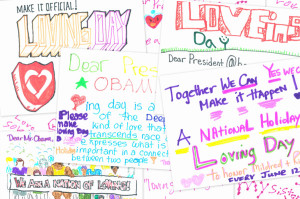
Mildred and Richard Loving, a black woman and a white man, married in Washington D.C. in 1958, and were arrested a few weeks after they returned home to Virginia. They pleaded guilty to charges of “cohabiting as man and wife, against the peace and dignity of Virginia”, and avoided jail time by agreeing to leave Virginia. They moved to Washington D.C. and wrote to US Attorney General Robert F. Kennedy. Kennedy referred the case to the American Civil Liberties Union. The US Supreme Court, headed by Chief Justice Warren, unanimously ruled in favor of the young couple. Afterwards, the couple lived together with their three children.
See The Loving Story trailer of the HBO movie.
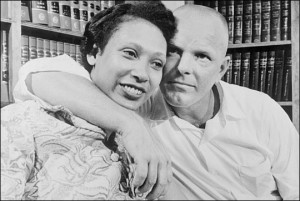 What Mildred Loving says mirrors what many of us say today, “I say that marrying who you want to is a right that no man should have anything to do with. It’s a God-given right, I think.”
The US Supreme Court currently considers another landmark decision in the field of marriage equality – Obergefell v. Hodges. The decision in that case is expected prior to the end of the Court’s term this month. They are scheduled to release opinions each Monday and Thursday this month through June 29th. Opinions are released at 10:00 am EST on those days. Where the Loving opinion was unanimous, no one dares to believe that the Obergefell decision will be the same. With a Court sharply divided on liberal versus conservative grounds, the swing vote will likely fall to Justice Anthony Kennedy, widely known to be the moderate middle vote. He authored opinions siding with gay rights in several prior cases, so the hope is that he will likewise author this opinion on the side of the right of same sex couples to marry.
The effect of the Obergefell decision here in Dallas, Texas remains to be seen. The Dallas County Clerk has announced the intention to be the first to issue marriage licenses to same sex couples when the opinion is released, and has requested budget money from Dallas County to staff clerks working overtime to accommodate the rush of couples to marry. “If the court rules in favor of same-sex marriage, within an hour and a half of the opinion, we’ll start issuing licenses,” said Dallas County District Clerk John Warren. (See Dallas County set to issue licenses if ruling favors gay marriage)
Hat tip to my favorite pastor Eric Folkerth for his blog It’s All About Loving. If you don’t read his blog, you should.)


 Texas Family Code section 160.106 says that the provisions of Chapter 160 relating to the determination of paternity apply to a determination of maternity in Texas. So, when a heterosexual couple is married, the father is presumed to be the father of the child. The law provides other instances when a man is presumed to be a father in a heterosexual relationship such as when the father signs an acknowledgement of parentage or allows himself to be named on the birth certificate. Interestingly, paragraph 5 of 160.202 allows for a presumption of paternity for a man who, during the first 2 years of a child’s life, resides in the household with the child and represents to others that the child was his own. Could this section be applied to a lesbian couple (married or not), when a child is born during the marriage to one mother, but the non-biological mother holds out to the world that the child is her own as well?According to 160.106, the same paternity presumption would apply to the maternity issues.
 ACP recommends that gender identity, independent and fundamentally different from sexual orientation, be included as part of nondiscrimination and anti-harassment policies.
 8, 2015, the Supreme Court of the United States held oral arguments in Obergefell v. Hodges – the combined group of 6 cases addressing the constitutionality of various states’ bans against same sex. Most Court watchers expect a ruling to come out by the end of June when the Court’s term ends. The next date when the Court will release opinions is May 26th.