


Every minute, 300 hours of video are uploaded to You Tube. People can create their own channels and provide systematic videos in the form of a video blog. Over time, certain video-sharers become pseudo-celebrities on their special topic. Here are four video blogs that are stellar resources on LGBT parenting issues. These video blogs are inspiring because they show the diversity of the modern family. These people are real and identifiable.

OliviaHas2Moms features Ebony and Denise and their beautiful daughter, Olivia. Ebony and Denis have been married for three years. They started their YouTube channel in 2011 and since then it has grown to 64,637 subscribers and has had 3,462,468 views.


Gay Family Values began in 2006 and currently has 35,705 subscribers and has had 6,959,204 views. This YouTube channel is separated into a few categories. “Ask A Gay Family” began as a response to California’s Prop 8. In these videos the entire family responds to personal questions, sent in by viewers, about their family, their personal views, or what it means to be a part of a gay family. “Gay Adoption Story” is another section of the YouTube channel where Bryan and Jay discuss the adoption process of their own children to help parents-to-be.


JiMONiC19 is an interesting YouTube channel because it features Jing and Monica, a lesbian couple, who have vlogged (video blogged) the entire process of making their family which came to be in 2014 when their daughter Estelle was born, including explaining the home insemination process. This can be very helpful for gay and lesbian couples who are looking to do the same thing. With 7,913 subscribers and 964,919 views, Jing and Monica and their daughter Estelle will most likely rise even farther into YouTube stardom in the coming years.


Michael and Luigi is a YouTube channel that documents the life of Michael and Luigi, gay fathers to Logan, their son. They currently have 2,993 subscribers and 132,249 views. For the most part, this YouTube channel has videos that show the lives of the family from their vacation to Disneyland to what the family did on Father’s Day.

https://youtu.be/ivPzoRl139o

Hat tip to Huffington Post here.
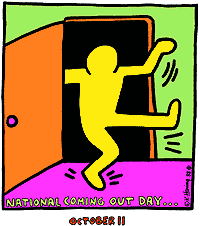
NCOD logoNational Coming Out Day is an annual civil awareness day internationally observed on October 11. Founded in 1988, the emphasis is that the most basic form of activism is coming out to family, friends and colleagues, and living life as an openly lesbian or gay person. The foundational belief is that homophobia thrives in an atmosphere of silence and ignorance, and that once people know that they have loved ones who are lesbian or gay, they are far less likely to maintain homophobic or oppressive views. The process of coming out involves self-disclosure of one’s sexual orientation and/or gender identity.
The day was chosen because it is the anniversary of the 1987 National March on Washington for Gay and Lesbian Rights.

The Huffington Post has a great article about how to make it easier for a child to come out. Here’s the gist of it.

Many young people across the country struggle with coming out to their family and friends as lesbian, gay, bisexual, or transgender (LGBT).  A parent might suspect his or her child is gay, or he or she may have no idea. Parents and other caregivers can make the way easier for the child both before and after they come out.

If your child has not come out:

1. Avoid jumping to conclusions. Many parents think they know who their child is, whether straight or gay. But it is important to let your child discover who they are on their terms in their time.

2. Recognize and address your concerns and fears. Many parents have fears about having a gay child. It is important to know that the parents are not alone in their fears and there are resources to help deal with the fears.

3. Show that you are open and accepting. Using disrespectful language to refer to other gay and lesbian people will discourage open communication with your child. Make your child feel safe by showing acceptance of other LGBT people.

4. Be approachable and available. Make time and space for your child to talk to you openly. Give them openings to talk about whatever is on their mind.

5. Show unconditional love in your actions and words. Tell your child that you love them for who they are and nothing can change that. Show your love by treating your child with care and respect.

After your child comes out:

Once your child comes out, your love and acceptance are the one thing that will make the biggest difference in your child’s health or wellbeing.

1. Show unconditional love in your actions and words. Remind yourself how much you love your child. Tell your child that you love them and that nothing can change that. This may be the thing your child most needs to hear. Even if you are uncomfortable with the news, show affection and avoid saying things that are hurtful.

2. Believe your child. They have probably thought long and hard about this, maybe even agonized over it, before coming out to you. Asking questions like “Are you sure?”, “How do you know?”, “Is this a phase?” won’t make your child feel accepted. They may feel that you are hoping that their identity will go away.

3. Acknowledge the courage it took. Coming out to you may have been the bravest thing your child has ever done. Even if it’s hard to hear, let your child know that you appreciate their openness and honesty.

4. Recognize and address your own concerns and fears. If you aren’t thrilled with the news, you don’t have to fake it. It’s okay to let your child know that it is hard for you. Your child probably went through a process to accept their identity and you may need this too. Ask your child to be patient with you.

5. Don’t out your child to others. Your child came out to you, but that doesn’t mean they are ready to be out with everyone. Respect their privacy. Ask permission before discussing it with others. If you need someone to talk to, find a way that you can do this without violating their trust.


2401 common lawThe new Obergefell decision is the beginning of marriage rights in Texas. But, with that comes many questions about how the new marriage rights apply to real people in their real situations. One question I heard recently —

We had a commitment ceremony several years ago. It was held in Texas. We have lived together in Texas the whole time. After that we told other people that we were married, and referred to each other “wife”, and didn’t really care what Texas law had to say. Do we need to have a ceremony now to be really married? Are we common law married?

The Obergefell decision held that same-sex couples are entitled to the same rights to the civil institution of marriage that heterosexual couples have.  The opinion discusses marriage licenses. So, the question arises as to whether Texas must permit same-sex couples to be informally married under Texas law.

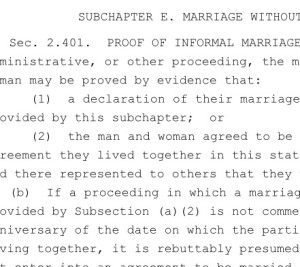
There are many misconceptions about what constitutes informal marriage in Texas. Sometimes it is also called common law marriage. To be common law married in Texas, two people must agree to be married, live together in Texas, and represent to others in Texas that they are married. Contrary to many lay opinions, there is no time requirement to be common law married. There have been instances where common law marriage has been found after just one day.

Also two people can fill out an informal marriage license with the county and declare their intent to be common law married, including the date as of which they intended to be married.

Another point, once two people meet the standards of informal marriage, they are married. They remain married until they divorce.

Now, back to whether informal marriage applies to same-sex marriages post-Obergefell.

The Family Code section 2.401 says that informal marriage may be between a man and a woman.

There is no law that says that Texas must recognize informal marriages at all. But, it seems that Obergefell is pretty clear that Texas must extend the same civil marriages to same-sex couples as heterosexual couples. So, Texas would have two options. First, they could repeal the informal marriage statute completely and only recognize marriages by license issued by the state. Many states do not allow for informal marriages, so Texas is not required to offer them at all. Second, if Texas is going to offer informal marriages, they cannot restrict them to heterosexual couples.

A district judge in the federal court in Beaumont recently applies the Obergefell decision to informal marriage. That decision is not binding on state courts, but can be instructive.

So, back to the question, if the couple in our question agreed that they were married at the time, and they lived together in Texas, and told people they were married, then YES they are probably informally married as of the date that they met all three of those steps.

I was fortunate to be asked to participate in the conversation on marriage equality leading up to and on June 26, 2015, the historic day when SCOTUS issued its Obergefell decision extending marriage equality to all and recognizing LGBT rights under the US Constitution.

Here’s a run down of my media appearances leading up to an including June 26, 2015’s historic day:

WFAA 8 – Three possible outcomes from marriage ruling 6/26/15 (video) Family Attorney Michelle May O’Neil speaks to News 8 about the three possible outcomes from the Supreme Court’s gay marriage ruling.

Texas Lawyer – SCOTUS’ Same-Sex Ruling Untangles Legal Remedies in Texas (Text Version) 6/26/15 (Text) “This is probably the most significant constitutional opinion of our generation. It extends the right to marry to a class of people that have never had that right,” said Attorney Michelle May O’Neil.

WFAA 8 – What marriage ruling means for Texas families 6/26/15 (video) Family Attorney Michelle May O’Neil talks to News 8 about what SCOTUS’ marriage ruling means for Texas families.

LXBN – Breaking: Supreme Court Rules Same-Sex Marriage Legal in All 50 States 6/26/15 (Text) “I think it’s everything that everybody hoped and thought it would be, and the historical significance is going to prove to be bigger than we realize today,” said Attorney Michelle May O’Neil. “This is kind of the constitutional rights decision of our generation.”

WFAA 8 – Attorney predicts same-sex marriage ruling coming Friday 6/24/15 (Text) DALLAS – History suggests the U.S. Supreme Court will decide on Friday whether to legalize same-sex marriage, said Michelle May O’Neil, a family law attorney. “I think this is probably the most important constitutional rights question of our generation,” she said.

Additionally, I wrote a blog posts

Expected Marriage Equality Decision on Friday, June 26

Marriage Equality – the Whole Enchilada that was featured on Dallas Morning News LGBTQ Insider Blog and LXBN (LexBlog Network), and received a Top 10 Blog Post of the Day Award from LexBlog.

Rome wasn’t built in a day; neither will LGBT equality. But, we have the cornerstones.

The conversation on LGBT equality continues and I’m honored to be part of it.

Following up on my commentary on the decision, I had the opportunity to discuss the Supreme Court’s landmark ruling on same-sex marriage with Colin O’Keefe of LXBN. In the interview, I discuss the implications of the decision going forward and how it’s playing out here in Texas.

In reflection on the historic June 26, 2015, where gay and lesbians won the right to marry whomever they wish in all 50 states including Texas, I am filled with happiness and sadness at the same time.

I am happy for all of the people that now have access to the legal institution of marriage. I am happy that these people are able to have the relationship with their partners that I enjoy with mine. I am happy for all of the other avenues this decision will open for the LGBT community. I am happy for the children of gay and lesbians who will have some of the stigma attached to their families removed.

But, I am also filled with sadness because as far as we have come for LGBT rights, we have farther to go, especially here in Texas. Dallas may be a little closer to the cutting edge, but we are surrounded by counties and government officials who are not. I am saddened by the government officials in Texas and probably in other states that are laying behind the log of religious freedom instead of doing the job the taxpayers pay them to do, issue marriage licenses. I am saddened by the religious officials that compare this ruling to the “last days” and to the end of the world just because two men or two women want to have a government license to join their lives together. I am saddened by the hyper-political nature of the Justices’ dissenting opinions – there derisiveness is indicative of the derisive nature of politics in our society today.rome wasnt built

All of this means that the Obergefell decision is just the beginning of obtaining liberty and justice for all in the LGBT community. Social acceptance and tolerance must still be won at the level of human interaction. After all, in 2008 even President Obama, who will herald the Obergefell decision into the annals of his legacy, said, “I am not in favor of gay marriage” because “I believe marriage is between a man and a woman.” He cited his religious beliefs in support of his position. He said this to a megachurch, he said it to MTV. He said it on the internet. (See President Barack Obama’s Shifting Stance on Gay Marriage.)

Then, in 2012, during an interview with Robin Roberts, President Obama announced clearly that he had changed his mind and decided to support the right of gay and lesbians to get married. He referenced staff members, friends, and family who are in committed same sex relationships as influential in his turnaround. (See Robin Roberts’ ABC News Interview with President Obama, May 9, 2012.)

So, as even President Obama turned around on gay rights because of his personal interaction with gay and lesbian people, it will take continued interaction and outreach between the gay community and the straight community to build acceptance that extends outside the four corners of the Obergefell decision. Rome wasn’t built in a day, as they say. And, so too, LGBT equality will not magically appear on June 26, 2015. But, June 26, 2015 provided the cornerstones of those rights upon which we can build for many years to come.


marriage equalityWith drama and historic significance, the US Supreme Court held today that same sex couples have a Constitutional right to marry. In so doing, they held that state bans against same sex marriage are unconstitutional. They also held that states must recognize marriages from other states.

Technically, the decision won’t take effect until the mandate issues – which takes about two weeks – but States are free to implement the result sooner.

Justice Anthony Kennedy wrote for the majority opinion, with a 5-4 split. The significance of Kennedy’s opinion will be remembered in history. Justice Kennedy wrote Lawrence v. Texas, decriminalizing homosexual conduct on June 26, 2003, as well as US v. Windsor, holding portions of the federal Defense of Marriage Act unconstitutional, on June 26, 2013. This decision, on June 26, 2015, will likely make Justice Kennedy a hero in the LGBT community.

The majority bases its conclusion that same-sex marriage is a fundamental right on “four principles and traditions”: (1) right to personal choice in marriage is “inherent in the concept of individual autonomy”; (2) the right to marry is fundamental because it supports a “two-person union unlike any other in its importance to the committed individuals”; (3) marriage safeguards children and families; and, (4) marriage is a keystone of our Nation’s social order.

Some quotes from the opinion:

“The Fourteenth Amendment requires a State to license a marriage between two people of the same sex and to recognize a marriage between two people of the same sex when their marriage was lawfully licensed and performed out-of-state.”

“This history of marriage is one of both continuity and change…. These new insights have strengthened, not weakened, the institution. Changed understandings of marriage are characteristic of a Nation where new dimensions of freedom become apparent to new generations.”

“The Fourteenth Amendment requires a State to license a marriage between two people of the same sex.”

“The marriage laws at issue thus harm and humiliate the children of same-sex couples.”

“When new insight reveals discord between the Constitution’s central protections and a received legal stricture, a claim to liberty must be addressed.”

“The nature of injustice is that we may not always see it in our own times. The generations that wrote and ratified the Bill of Rights and the Fourteenth Amendment did not presume to know the extent of freedom in all of its dimensions, and so they entrusted to future generations a character protecting the right of all persons to enjoy liberty as we learn its meaning.”

“Rising from the most basic human needs, marriage is essential to our most profound hopes and aspirations.”

“Marriage responds to the universal fear that a lonely person might call out only to find no one there. It offers the hope of companionship and understanding and assurance that while both still live there will be someone to care for the other.”

“By giving recognition and legal structure to their parents’ relationship, marriage allows children to understand the integrity and closeness of their own family and its concord with other families in their community and in their daily lives.”

“Marriage also affords the permanency and stability important to children’s best interests.”

“Without the recognition, stability, and predictability marriage offers, their children suffer the stigma of knowing their families are somehow lesser.”

From the concluding paragraph of the majority opinion: “No union is more profound than marriage, for it embodies the highest ideals of love, fidelity, devotion, sacrifice, and family. … [The challengers] ask for equal dignity in the eyes of the law. The Constitution grants them that right.”

Each of the 4 dissenting justices wrote separate dissenting opinions, each scathing in its own right.

The Chief Justice has the principal dissent, which is 31 pages long. Toward the end of it, he says, “If you are among the many Americans–of whatever sexual orientation–who favor expanding same-sex marriage, by all means celebrate today’s decision. Celebrate the achievement of a desired goal. Celebrate the opportunity for a new expression of commitment to a partner. Celebrate the availability of new benefits. But do not celebrate the Constitution. It had nothing to do with it.”

Justice Scalia’s dissent leads off by saying that the decision is a “threat to American democracy.” He concludes by saying that “Hubris is sometimes defined as o’erweening pride; and pride, we know, goeth before a fall. . . . With each decision of ours that takes from the People a question properly left to them–with each decision that is unabashedly not based on law, but on the ‘reasoned judgment’ of a bare majority of this Court–we move one step closer.”

Justice Thomas’ dissent takes issue with the law of substantive due process generally and concludes by stating that the majority’s conception of liberty will have “inestimable consequences for our Constitution and our society.”

Justice Alito’s dissent expresses a fear that today’s decision will cause anybody who opposes same sex marriage to be vilified and branded as bigots.

june26It is widely expected that the Supreme Court of the United States will issue their opinion in the Obergefell case defining the rights of same-sex couples to marry on Friday, June 26, 2015. The Supreme Court rarely announces the date upon which it will issue an opinion in a case and there are never any leaks of that information. However, several clues are leading everyone to the conclusion that it will be Friday.

First, the Supreme Court usually issues opinions on Mondays. Toward the end of the term they add dates to issue additional opinions. Usually, additional opinions are released on Thursdays. Last week they announced an additional opinion issue date on Friday, June 26, 2015.

Second, it is likely that they will want to issue the Obergefell decision independently of any other decisions. There’s so much attention focused on this decision. It could be disruptive to have other opinions issued the same day.

Third, June 26 is a significant day in the history of LGBT rights in America. Twelve years ago on that date June 26, 2003, the US Supreme Court issued its opinion in Lawrence v. Texas. Authored by Justice Kennedy, Lawrence held unconstitutional the statutes that criminalized homosexual conduct. Ten years later, on June 26, 2013, the Supreme Court issued its opinion in U.S. v. Windsor. This case was significant for LGBT rights in America because it held a portion of the federal defense of marriage act unconstitutional. It made federal government benefits applicable to LGBT couples. Interestingly, the Windsor opinion was also authored by Justice Kennedy.

Most believe that Justice Kennedy will be the swing vote in deciding the Obergefell decision. Out of the nine justices, four are known to be liberal-leaning. Another four are known to be conservative-leaning. Justice Kennedy tends to be the moderate in the middle.

There are two questions that are before the Supreme Court in the Obergefell case. The first is whether LGBT couples should have the same right to marry as heterosexual couples, giving rise to a right of equal protection under the law. If Justice Kennedy sides with the four liberal justices in answering this question yes then the second question does not even matter.

If a majority of the justices vote “no” on question one then the court could consider question two. The second question is whether States must recognize gay marriages performed where they are lawful, even if unlawful in the state where the couple seeks recognition. Based on the tenor of the justices questions in oral argument it seems possible that one or two of the conservative block of justices could even agree to question two.

Most court watchers believe it is highly unlikely that the justices will answer questions one and two with a no.

And so the country waits for Friday, June 26, 2015. Most likely this will be another significant day in LGBT rights in America.


TX-Supreme-CourtAfter a long 2 year wait, the Texas Supreme Court finally issued rulings in the two same-sex divorce cases pending before it. One involved two men from Dallas — In re JB and HB. The other involved two women from Austin — Naylor v. Daly. Unfortunately, we are no closer to understanding how married same-sex couples living in Texas should address the dissolution of their relationships. And… it took 2 years to get here.

The first case, In re JB and HB, came out of Judge Tena Callahan’s court in Dallas County, Texas. Her ruling was heralded when she courageously held the Texas law prohibiting recognition of same-sex marriages in other states for purposes of conducting a divorce as unconstitutional. This case was anticipated to be THE case that would give us clarity on how to handle out of state marriage that wish to dissolve in Texas. Unfortunately, one of men passed away in April 2015. A divorce case is rendered moot upon the death of one of the parties and cannot be continued.  The Texas Supreme Court dismissed the case on June 19, 2015. A disappointing result for Texas jurisprudence.

The second case, Naylor v.Daly, out of the Austin area, presented a more technically challenging issue. At the trial court level, Naylor and Daly sought to dissolve their marriage. At first, the ladies disagreed as to whether a divorce under Texas law was proper or not, but then eventually reached a settlement of their disputes and entered an agreed divorce. Only after their case was finalized did the Texas Attorney General, then headed by now-Governor Greg Abbott, file pleadings to challenge the constitutionality of the trial court’s grant of divorce.

The Texas Supreme Court held that the Texas Attorney General waited too long to file his pleadings and therefore lacked the right to intervene and challenge the judgment. He could not wait until the case was over and judgment final to intervene. That was too late. So, according to the Texas Supreme Court, the same sex divorce stands. Now the opinion wades through a lot of jargon about the Texas constitutional definition of marriage being one man and one woman, etc. etc. But at the end of the day, procedure reigned and the OAG was just too late to complain.

I am concerned that many in the LGBT community will misinterpret this decision as a sanctioning of filing same-sex divorce cases for LGBT couples living in TExas who weremarried elsewhere. Tod Robberson, writing on the Dallas Morning News Opinion Blog, for example, goes there his headline Texas Supreme Court allows same-sex divorce, which means marriage can’t be far offOh, Tod, how wrong you are, and how disappointed many people are going to be.

Here’s my comment response to Tod’s blog post:

Tod, I think your headline expands today’s decision into unsupported territory. The opinion *was* decided on a technicality. Therefore, it does *not* support the general conclusion that same-sex divorces may go forward in Texas. The crux of the opinion says that the Attorney General must be MORE diligent in challenging same sex divorces under Texas law, instead of waiting until the case is over as he did in Naylor. The opinion delves very deeply into Texas’ constitutional definition of marriage as one man, one woman. As a family law attorney for 23+ years, and as an LGBT ally for all of those years, I believe this opinion only goes to far as to say — if you manage to file a same-sex divorce without the OAG finding out, and proceed to a final judgment without the OAG finding out, then your divorce is final. If, however, the OAG finds out and challenges the jurisdiction of the Texas court to maintain the divorce based on our constitutional parameters, then the case will head up on appeal, with great expenditure of attorneys fees, time, and emotional resources.

Admittedly, as an LGBT Ally and Advocate, the limitations of this decision are disappointing. Also disappointing is the dismissal of the J.B. case, also dealing with the right of same-sex couples to get a divorce in Texas, due to the death of one of the parties.

I hate for same-sex couples out there to read your column and get their hopes up that they can now have unrestricted access to the Texas court system to dissolve their marriages. This Naylor opinion does NOT support your conclusion and many folks will be disappointed in relying on your column for legal advice. However, the Supreme Court of the United States should rule in a few days to provide the clarity the Texas Supreme Court failed to provide.

So, for a few more days, Texas remains in limbo. We expect the Supreme Court of the United States to enlighten us sometime this month. Only then will we know for sure how to approach same-sex divorces in Texas.